27 January 2017
After an eventful 2016, the University of Edinburgh International Office was delighted to host an in collaboration with the Royal African Society (RAS), the British Council, the Centre of African Studies and the Sustainable Business Initiative to explore the prospects and forecasts for Africa in 2017.
- International Office, University of Edinburgh
- Royal African Society
- British Council
- Centre of African Studies, University of Edinburgh
The event sought to examine the key trends and events likely to shape the continent in the upcoming year and beyond. The engaging and inspirational speakers included:
- Dr Njoki Ngumi (The Nest Collective, Nairobi, Kenya)
- Dr Kate Wright (Centre of African Studies, University of Edinburgh, UK)
- Professor Paul Nugent (Centre of African Studies, University of Edinburgh)
- Jane Salmonson (Chief Executive of Network of International Development Organisations in Scotland (NIDOS))
The panel was chaired and questions facilitated by Dr Barbara Bompani (Centre of African Studies, University of Edinburgh).
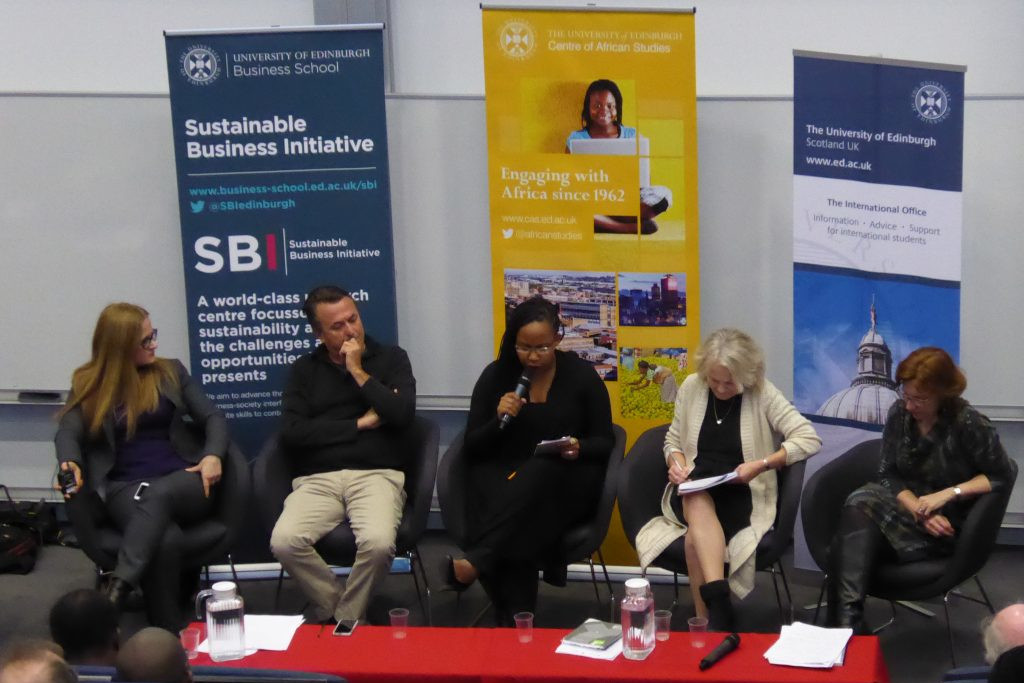
The key points covered by each panel member included:
Dr Njoki Ngumi: She interrogated the ‘Africa Rising’ narrative, which has come to dominate discussions of the future of the continent. Too infrequently, she said, these discussions fail to consider difficult questions like, “what are we rising to?”, “what are we rising past?” and “for whom”? Too often approaches to development do not pay sufficient attention to inclusivity. For example, there is a huge emphasis on job creation as a central pillar of economic development, but this is limited if it does not also create meaningful reductions in inequality. Likewise, there is an issue with the celebration of modernising African cities when it results in highly exclusive and limited spaces.
The power-centres of the world are changing post-Trump, and there is a necessity for Africa to forge its own course. It should imagine its own future free of northern imaginaries. In this, the arts and cultural industries will play a central role, and it is thus important to have continued freedom of expression, which should be a crucial human right.
Prof Paul Nugent: His focus was on politics and in particular the prospects in 2017 for democracy. The Kenyan elections will be the key bellwether for democracy on the continent. If there is no violence it will be a big step forward. The decision-making process on who succeeds Jacob Zuma as leader of South Africa’s African National Congress (ANC) will also be important to watch.
Dr Kate Wright: Discussed the major shifts taking place in who covers Africa and the fact that major international news agencies are increasingly cutting back on the use of foreign correspondents. The gap is being filled often by local freelancers. This does mean that more Africans are reporting the news on the continent to western audiences, but often doing so in very insecure, vulnerable conditions of employment and with little control over content. NGOs are also starting to fill this gap, which has implications for objectivity. She also expressed concern about the implications of the accelerating news cycle for our understanding of African issues – will events like the crisis in South Sudan be reported without resorting to clichés?
Jane Salmonson: Focused her presentation on the role of international governments in development. She voiced concern that the current UK government does not share the same commitment to international development as previous administrations. This is spurred on by misleading attempts to stir up controversy by the right wing press in the UK. The prospects for aid budgets do not look good, and there is a heightened need to make the positive case for development assistance and international solidarity. The United Nation’s Sustainable Development Goals provide a rallying point, since they apply universally.
With such a diverse range of topics covered, attendees asked a breadth of questions to get more insights from the experts as well as challenge their perspectives. After concluding thoughts from Dr Bompani, the attendees enjoyed networking at a drinks reception.
As the University of Edinburgh continues to build a strong relationship with the Royal African Society, this event will run annually at the Business School. We look forward to seeing you in January 2018 to reflect on and celebrate another great year and discuss prospects and forecasts going forward!